

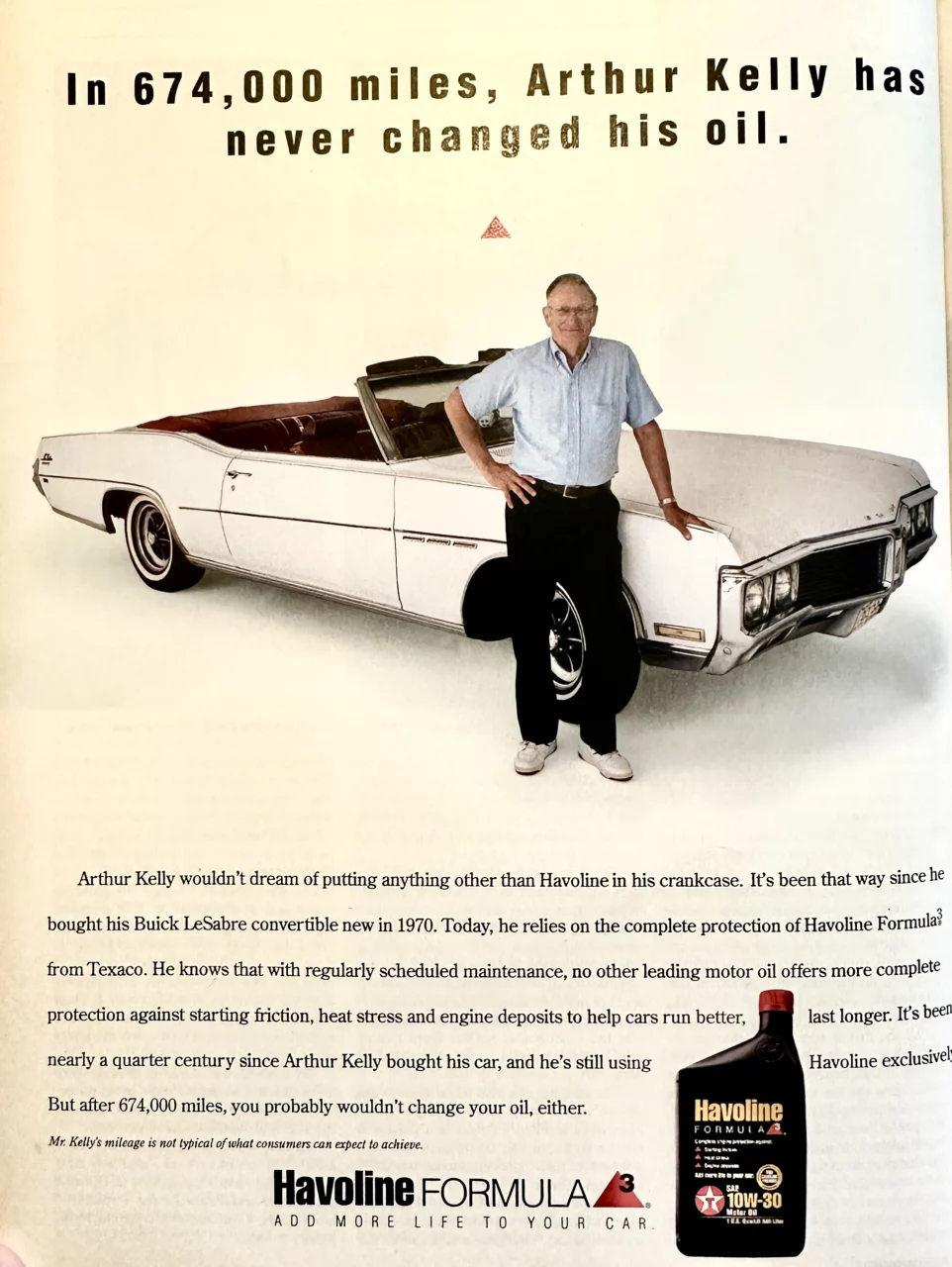
While thumbing through an older (1995-era) issue of Car and Driver magazine, I came across an advertisement for Havoline motor oil. It showed a man named Arthur Kelly who owned a 1970 Buick LeSabre convertible, racked up 674,000 miles on the car, and “never changed his oil” (except he did change it — he just always used the same brand of oil). Motor oil always seems to be a hot topic (pun intended), and the ad provoked some questions.
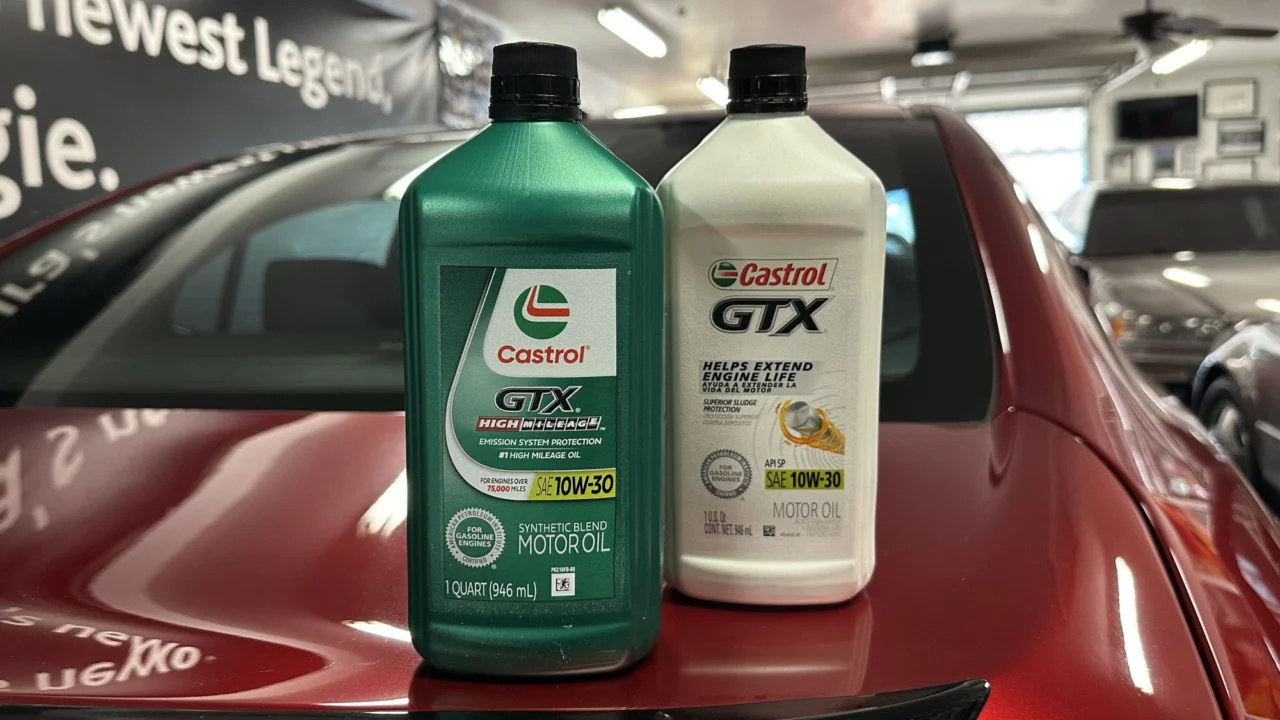
My 1994 Acura with 601,000 miles on it has received 187 oil changes. That comes out to an oil change every 3,219 miles over the car’s 32-year lifespan. In more recent years, I’ve been using a “synthetic blend” oil type. What exactly does that mean? Here’s a short guide:
- Conventional – Derived directly from refined crude oil. It is said to break down relatively quickly under high heat or heavy loads.
- Synthetic blend – This is considered a mid-grade option, made up of a mixture between synthetic and conventional base oils.
- Full synthetic – Chemically engineered with few impurities. It is said to flow better in extreme temperatures and is less prone to break down, resulting in longer intervals between changes, improved fuel efficiency, and reduced engine wear.
- “High mileage” – Formulated with seal conditioners that are said to reduce oil consumption and leaks. Intended for vehicles with more than 75,000 miles.
This might also be a good opportunity for a crash course on oil grades. I found a handy graphic from U.S. Lubricants as shown below.
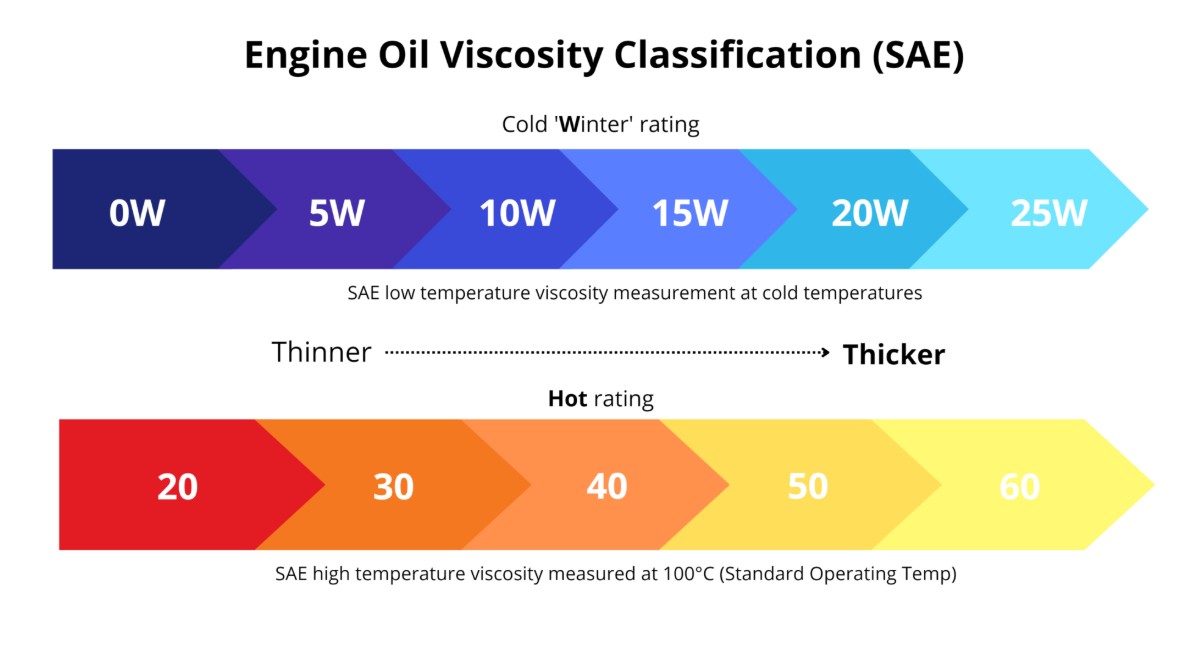
There are 14 classes of oil viscosity that were established by the Society of Automotive Engineers (SAE): six “winter” classes and eight “summer” classes. An oil grade will designate both. For example, “5W-20” is oil with a viscosity rating of five at cold temperatures (“W” for winter) and a viscosity rating of 20 when the engine is at normal operating temperature. (In case you wanted to know, the normal operating temperature for most cars ranges from about 190-225 degrees Fahrenheit.)
So, which weight and change interval is optimal?
That depends! The manual for my Legend says to use a 5W-30 oil, but does not specify its type. Also worth noting: It calls for a 7,500-mile interval, which is twice as much as I’ve been running each change.
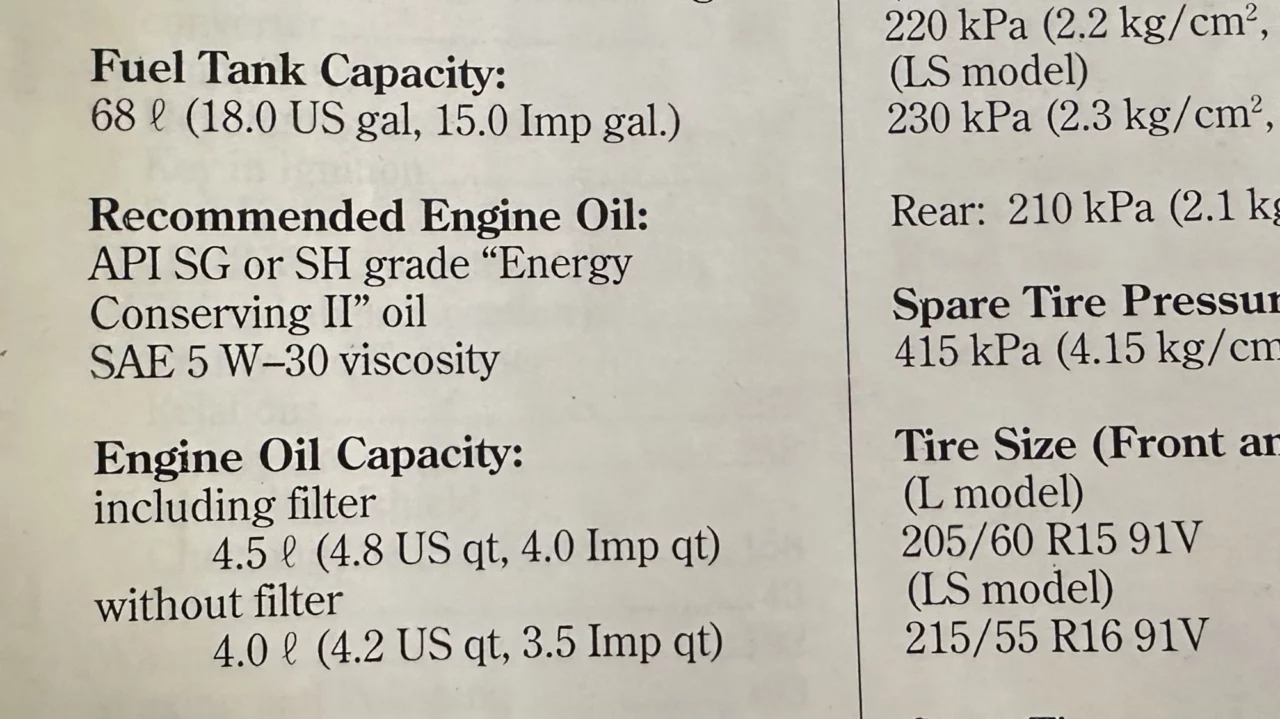

Clearly, I’ve been doing something right when it comes to maintaining my Legend, but what about my newer car?
My 252,000-mile 2013 Acura ILX uses 0W-20 fully synthetic oil. Instead of going by the old “every 3,000 miles” rule of thumb, I let the car’s computer (which Acura calls the Maintenance Minder) tell me when it’s time to schedule service. Usually, when the readout says that I have 15 percent oil life remaining, I schedule an appointment. That car has received 36 oil changes over its 13 years, which comes out to exactly 7,000 miles between changes. So, with synthetic oil, the ILX is being driven more than double the number of miles that the Legend does on a change of “blend.”
I might be opening up Pandora’s Box by asking this question, but I’ll do it anyway: Which brand, weight, and change interval do you swear by for your classic or modern vehicle?
