

It’s another behind-the-scenes podcast!
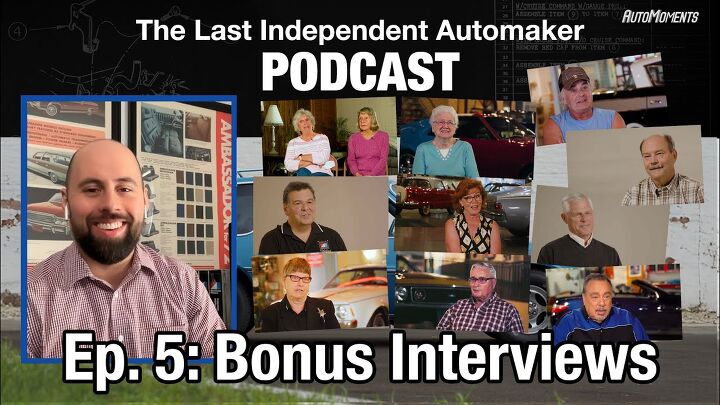
This time producer Joe Ligo is sharing bonus interviews that didn’t make it into the final cut of the documentary. Everyone we interviewed for the series had great stories, but unfortunately the 3-hour time limit meant that some stories had to be cut. This is our way of honoring those who were kind enough to let us interview them.
This group of 11 includes former AMC factory workers, office workers, a designer, an engineer, a friend from the Kenosha History Center, and even the legendary Pat Goss from MotorWeek!
Interviews include:
John Sgalia – AMC Designer
Richard Ray – AMC Product Planning / Marketing
Tom Jettie – AMC Electrical Engineer
Mary Ann Moran and Celia Stankorb – AMC Analysts / Secretaries
Minne Cox-Laudonio – AMC Factory Worker / Office Worker
Kathleen Watring Rader – AMC Office Worker
Al Gabriel – AMC Factory Worker
Bobby Allen – AMC Factory Worker
Cynthia Nelson – Kenosha History Center Staff
Pat Goss – Master Technician, MotorWeek
The TTAC Creators Series tells stories and amplifies creators from all corners of the car world, including culture, dealerships, collections, modified builds and more.
A transcript, cleaned up via AI and edited by a human staffer, is below.
[Image: YouTube Screenshot]
Become a TTAC insider. Get the latest news, features, TTAC takes, and everything else that gets to the truth about cars first by subscribing to our newsletter.
Transcript:
My dad was proud to work there. My uncles—my whole family—were proud to work there. And I was proud to work there too. It was a good place to work. You could make a good living there.
The Last Independent Automaker podcast was sponsored in part by Visit Detroit, the Alfred P. Sloan Foundation, Motor City’s National Heritage Area, and by more than 375 individuals and organizations who donated to this project. Thank you.
Hello, and welcome to The Last Independent Automaker podcast.
Today’s episode is a little different. There are no guests, no interviews, and even Jim and Pat—my co-producers—aren’t here. But before you click away, let me explain what we’re doing. We’re taking some time to share interviews from people who, unfortunately, didn’t make it into the final cut of the film.
If you’ve followed us on Facebook, you know we interviewed dozens of people for this project—around 50 or 51 in total. Only about 35 interviews made it into the final documentary. That wasn’t for personal or political reasons. We were limited to three hours and had to pack in an enormous amount of information. Simply put, we couldn’t fit everyone in.
That said, these people were incredibly generous with their time, and they shared some truly great stories. We wanted to recognize them and give you the chance to hear some of what they had to say.
Let’s jump right in.
First, I want to recognize John Chagalia. He was a designer at American Motors and Jeep, joining the company in the mid-1970s. John was friends with Vince Gerace, Frank Pasco, and other AMC styling figures, and he shared some fascinating insights.
One topic we did touch on in the documentary was AMC’s approach to parts sharing. That philosophy went back to the Nash and Rambler years, but AMC really leaned into it with vehicles like the Hornet, Javelin, and AMX. John explained how shared components were used intelligently, not cheaply, allowing designers to vary materials, finishes, and value levels while controlling costs.
He pointed out that AMC was likely ahead of its time. While other manufacturers created new parts simply because they could, AMC focused on using what they already had as efficiently as possible. One example he loved was the fact that the first- and second-generation Javelins used the same door stampings—a detail most people would never notice.
John also offered a thoughtful perspective on government regulations. Many people argue that safety and emissions rules made cars uglier or restricted designers creatively. John acknowledged the challenges but described a moment that changed how he viewed his work. He encountered a wrecked Hornet at a dealership and realized these components weren’t just sculptures—they were elements meant to protect real people.
As regulations evolved, interior components had to meet strict requirements for softness, energy absorption, and impact safety. Over time, these constraints became second nature. Rather than stifling creativity, John felt they gave designers meaningful problems to solve.
That insight stuck with me. As an enthusiast, it’s easy to dismiss regulations entirely, but John helped me see that sometimes there’s a higher purpose—designing cars that people can survive.
Next is Richard Ray, who worked in product planning and marketing. Those roles overlap more than you might expect, as both focus on understanding what consumers want.
Rich talked about the first time he saw the car that would become the Renault Alliance. Renault, which owned part of AMC at the time, asked him to forecast U.S. sales before he’d even seen the vehicle. After reviewing clay models and spending an overnight session crunching numbers, his team settled on a forecast of 105,000 units. Remarkably, that number held through years of development and ended up being accurate for the first year—though, as Rich admitted, partly for the wrong reasons.
He also described how the car was adapted for the U.S. market, with changes to bumpers, interiors, and safety systems. The flexibility of the platform helped the Alliance succeed.
Rich also shared a story from his time working on Jeep marketing, specifically around the Quadra-Trac four-wheel-drive system. Claiming best-in-class traction wasn’t enough—it had to be proven. AMC hired an independent test facility, compared Jeep against GM and Ford competitors, and worked closely with lawyers to substantiate every claim. Weather delays, melting ice at high altitude, and legal back-and-forth were all part of the process, but the claim ultimately made it to market.
Another interviewee was Tom Jetty, an electrical engineer who worked at Ford and later at AMC and Jeep. He explained how critical emissions compliance was in the 1970s. If a vehicle configuration didn’t pass emissions testing, it couldn’t be sold—period. Emissions-related projects had effectively unlimited budgets and demanded long hours, including weekends and holidays.
Tom also worked on the Jeep XJ and ended up responsible for the horn—an overlooked but legally required component. Packaging it among crowded engine bay components, meeting European noise regulations, and defending its placement early in the design process were all part of the job.
After Chrysler acquired AMC, Tom continued working there and shared a memorable story from the Jeep Liberty program. Early on, the team agreed to place window switches on the center console, a common European layout. While it simplified wiring, American customers hated it. By the time the feedback came in, changing the design would have cost roughly a million dollars, so it stayed. Money, as Tom noted, always factors into decisions.
Two particularly kind interviewees were Mary Anne Moran and Celia Stancorob. They welcomed us into their home, offered coffee and cake, and shared stories from their time working as analysts and secretaries. Their careers coincided with the early introduction of personal computers in the workplace, including the Wang word-processing systems. Mary Anne even kept one of the massive floppy disks from that era.
They recalled concerns about eye strain, frequent system crashes, and reliance on IT support—early growing pains of office computing. They also talked about the AMC vehicles they drove, often purchased with employee discounts, including the Renault Alliance.
In Kenosha, we spoke with many people who worked both on the assembly line and in office roles. Minnie Cox Ladonio shared insights into workplace dynamics, including ethnic divisions within management and how early computer adoption changed office staffing. In one case, the arrival of computers prompted an older coworker to retire rather than adapt.
Kathleen Watering-Raider shared stories about employee parking policies—AMC drivers parked closer—and buying unusual off-lease executive cars, including a uniquely optioned Gremlin. She also talked candidly about balancing work and family, weighing good pay and benefits against the desire to raise her children.
Al Gabriel, who joined AMC in 1958 during the Rambler boom, recalled relocating to Kenosha with friends in search of work, struggling to find housing during AMC’s hiring surge, and attending company-wide events led by George Romney. He even remembered seeing the one-off pink AMX built for Playboy come down the assembly line.
Bobby Allen described working on Pacers, which he called a challenge due to packaging issues and early brake system problems. Despite its quirks, he appreciated the car’s visibility and interior space, even if it earned the nickname “the egg.”
Looking back, nearly everyone we spoke to shared a common sentiment: pride. Pride in their work, their coworkers, and the company itself. As Bobby put it, while a few people didn’t care, the vast majority were proud to work at AMC. Their families were proud, and it provided a good living.
Finally, I want to recognize Cynthia Nelson of the Kenosha History Center, who spoke about Nash and AMC’s role in helping immigrant workers integrate through language classes and education programs. She highlighted how the auto industry provided stability, opportunity, and a path into American life for many families.
The last person I want to mention is Pat Goss, best known from MotorWeek, who passed away in 2022. I was fortunate to interview Pat while working there, though his segment didn’t make it into the final documentary due to its highly technical nature.
That wraps up our recognition of the people whose stories didn’t make the final cut, but whose contributions were no less meaningful.
