

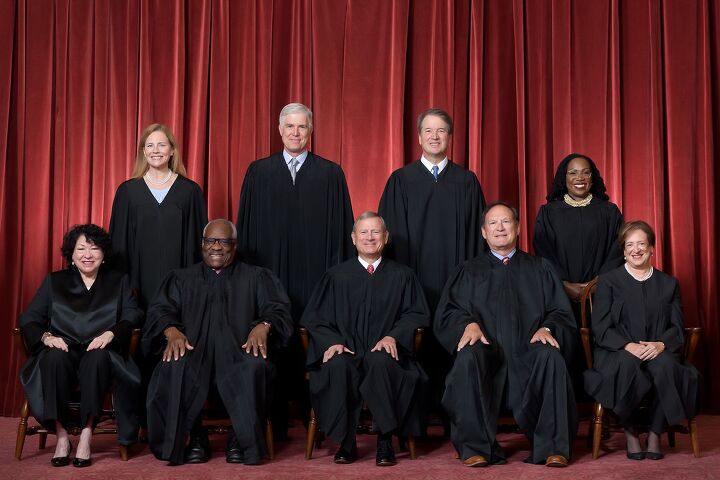
The Trump administration may be looking to offer $200 billion in store credits to importers after the Supreme Court ruled 6-3 that he lacked the authority to impose tariffs.
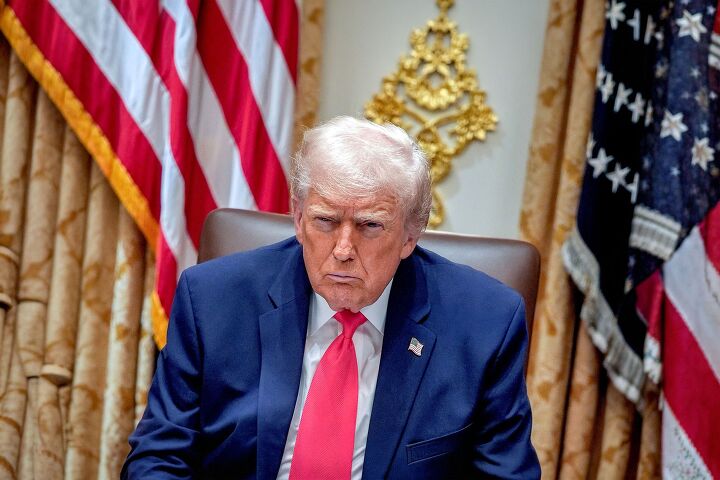
Trump claimed the International Economic Emergency Powers Act of 1977 gave him broad powers, including the power to levy tariffs against hostile countries. Many were quick to note the country isn’t in a state of emergency, and even so, the law doesn’t give him that power — and the majority agreed.
“The president asserts the extraordinary power to unilaterally impose tariffs of unlimited amount, duration, and scope,” Chief Justice John G. Roberts Jr. wrote for the majority. “In light of the breadth, history, and constitutional context of that asserted authority, he must identify clear congressional authorization to exercise it.”
Writing for the minority, Justice Brett Kavanaugh said attempting to refund $200 billion could result in a “mess.” He added, according to the New York Times, the country may need to do so despite the fact that “some importers may have already passed on costs to consumers or others.”
Trump reportedly called the ruling “a disgrace” while talking with U.S. governors, the Times reported.

While the ruling is clear about what Trump cannot do, it’s unclear what the next steps will be for the administration, as well as the companies that have paid more than $200 billion in tariffs thus far. Some have sued the Trump administration, looking to be repaid.
Conversely, U.S. Trade Representative Jamieson Greer has repeatedly said in the past several weeks that the administration has other options if the ruling went against it. Several reports have suggested enacting Section 301 tariffs from the 1974 Trade Act, writes The Hill, which allows for levies against countries the U.S. Trade Representative determines are engaged in unfair trade practices.
However, aside from being a giant time suck — each country must be singled out, undergo investigations and then negotiate a new deal — it cannot be used as a backstop to keep the funds collected due to previous rulings by the Court of International Trade and the Court of Appeals for the Federal Circuit. And the defendant? Trump, during his first term.
Toyota, which is already suing through subsidiaries, reported tariffs cost it $8 billion and Ford noted it was a $2 billion drag on its bottom line. They’ve been making nice with the Trump administration about this issue, but now it could be used as leverage against the administration in future dealings about taxes, emissions, and, well, tariffs.
[Images: Supreme Court, White House, Toyota]
Become a TTAC insider. the latest news, features, TTAC takes, and everything else that gets to the truth about cars first by subscribing to our newsletter.
