

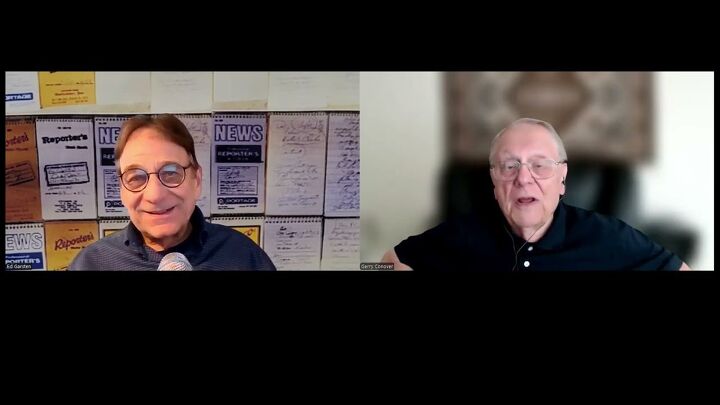
Gerry Conover has a unique view of both the auto and news industries after spending more than years at Ford Motor Co. and 45 years as a journalist.
He’s journalist Ed Garsten’s guest on episode 135 of Tales From the Beat, the podcast that looks at news and PR from both sides of the scrimmage line. In the episode, Gerry offers his frank views on auto news coverage, PR practices and discusses his auto newsletter that’s always stuffed with inside industry info.
TTAC Creator Ed Garsten hosts ” Tales from the Beat,” a podcast about the automotive and media worlds. A veteran reporter and public relations operative, Garsten worked for CNN, The Associated Press, The Detroit News, Chrysler’s PR department and Franco Public Relations. He is currently a senior contributor for Forbes.
The TTAC Creators Series tells stories and amplifies creators from all corners of the car world, including culture, dealerships, collections, modified builds and more.
A transcript, cleaned up via AI and edited by a staffer, is below.
[Image: YouTube Screenshot]
Become a TTAC insider. Get the latest news, features, TTAC takes, and everything else that gets to the truth about cars first by subscribing to our newsletter.
Transcript:
Ed Garen:
With more than 30 years inside Ford Motor Company and 45 years as a journalist, Jerry Conover brings a unique perspective on what defines value on both sides of the communications scrimmage line. He’s my guest on Episode 135 of Tales from the Beat, where we explore news and PR from both sides of that divide.
I’m Ed Garen. Jerry, thanks for joining me.
Jerry Conover:
Ed, thanks very much for having me. I’ve been looking forward to this.
Ed Garen:
Same here. We’ve exchanged messages and seen each other’s work, but never actually spoken. So let’s jump right in. You’ve had a wide-ranging career—media, automotive, even the military. Can you give listeners a broad overview?
Jerry Conover:
Sure. I actually started out as an engineer—earned two mechanical engineering degrees from the University of Michigan. Naturally, the auto industry was the place to go. I also served on active duty in the military during the Vietnam era, which gives you an idea of how far back this goes.
I joined Ford, though I originally thought I’d end up at Chrysler, which was considered the top engineering company at the time. Instead, I started at Ford in product planning, which isn’t exactly engineering. Over about three years, I moved through product development, manufacturing, technical affairs, and eventually corporate strategy.
I retired in 2002, but I’d already been writing internally at Ford for about 20 years. One of my roles included editing and publishing a quarterly technical magazine. That’s where I learned that writing isn’t just about technical language—it’s about storytelling.
Over time, I transitioned into public affairs and spent roughly the last 15 years as a company spokesperson, particularly around intelligent transportation systems—long before that became mainstream.
After retiring, I decided to apply those analytical skills to writing. I launched a newsletter and eventually found an audience interested in my perspective. I’m now heading into my 25th year doing that.
Ed Garen:
That’s impressive. And the name of the newsletter?
Jerry Conover:
Cars Smart News. The company is Carsmart.info.
Ed Garen:
I’ve read it—it’s packed with insight and forward-looking ideas. Let’s talk about what you’re seeing in the industry right now. What are the major issues?
Jerry Conover:
Well, if you look at any front page today, it’s all about oil. There’s conflict in the Middle East, and while it will affect oil markets, I don’t think it will have a massive long-term impact on the U.S.
The U.S. is a net energy exporter, particularly of refined products like gasoline and diesel. We do import about a third of our crude, but that’s mostly heavy or sour crude that our older refineries are designed to process. So imports are more about logistics than necessity.
Only about 10.8% of U.S. petroleum imports come from the Middle East. So while there’s an effect, it’s somewhat limited.
Ed Garen:
We’ve already seen gas prices react. Do you think this is temporary, or could it lead to long-term changes like we saw in the 1970s?
Jerry Conover:
There are two parts to that. First, I think the geopolitical situation will last longer than a couple of weeks. Second, the price spikes we’re seeing are largely driven by futures markets—speculators reacting to perceived risk.
When oil hits $100 per barrel, that’s often a futures price, not what refiners are currently paying. But markets react quickly, and prices at the pump follow.
Is it a disaster? Not yet. If gas hits $5 per gallon, that’s serious. At $4, it’s uncomfortable but manageable.
Ed Garen:
Will this influence vehicle buying behavior?
Jerry Conover:
To some extent, yes. But affordability is already a major issue. With average transaction prices around $50,000, many buyers are priced out regardless of fuel costs.
Even at $5 per gallon, EVs don’t necessarily make financial sense without incentives if they cost $45,000 or more. Hybrids and extended-range vehicles are more realistic options, but there’s limited manufacturing capacity.
I wanted a hybrid Ford Explorer myself, but supply is so constrained that they’re mostly going to fleet and specialty buyers.
Automakers are in a tough spot—they can’t pivot production quickly enough, and investing heavily in one direction carries risk if demand shifts again.
Ed Garen:
Let’s shift to media coverage. Do you think the story is being told fairly and objectively?
Jerry Conover:
That’s a tough question. Many journalists are well-trained, but not all have deep expertise in specialized areas like energy or automotive.
Beat reporters—those who cover the same topic consistently—tend to produce more accurate, balanced reporting. Others rely on sources like Reuters or Bloomberg, which have subject-matter expertise.
The challenge is time pressure. Reporters often have minutes, not hours, to produce stories. That can lead to oversimplification or reliance on incomplete information.
And yes, there’s increasing political polarization in how stories are framed.
Ed Garen:
Do you think audiences are gravitating toward sources that reinforce their views?
Jerry Conover:
Absolutely. People tend to choose sources they’re comfortable with. Data from organizations like Pew Research shows growing polarization.
The concern is that many people are getting information from sources that may not be well-informed or neutral. That increases the risk of misinformation.
I always say it’s better to be uninformed than ill-informed.
Ed Garen:
What about journalism as a profession? Enrollment is down, and anyone can publish online now.
Jerry Conover:
That’s a real concern. Professional journalists follow ethical standards, which are essential. Independent voices are fine—they provide opinion—but audiences need to understand the difference between opinion and reporting.
Even traditional outlets are seeing more opinion creep into reporting. It’s becoming harder for consumers to distinguish between the two.
Ed Garen:
Let’s talk about the PR side. Has it changed much?
Jerry Conover:
Not as much as you might think. PR professionals still aim to tell their company’s story in the best possible light—without crossing into falsehoods.
There’s still a lot of outreach—calls, pitches, messaging. The difference is that even smaller companies now use professional communicators.
The key is for journalists to evaluate those messages critically. Some pitches are well-grounded; others oversell.
Ed Garen:
I made the jump from journalism to PR years ago and found that many companies didn’t fully understand how news works.
Jerry Conover:
That’s why former journalists often excel in PR roles. They understand what makes a story relevant and credible.
Ed Garen:
Before we wrap up, where can people find your newsletter?
Jerry Conover:
It’s called Cars Smart News. We offer enterprise subscriptions—companies subscribe rather than individuals. Anyone interested can contact me at jerry@carsmartnews.com.
Ed Garen:
Jerry, great finally speaking with you.
Jerry Conover:
Likewise. I look forward to meeting in person.
Ed Garen:
Thanks for joining us on Tales from the Beat. I’m Ed Garen—see you next time.
