

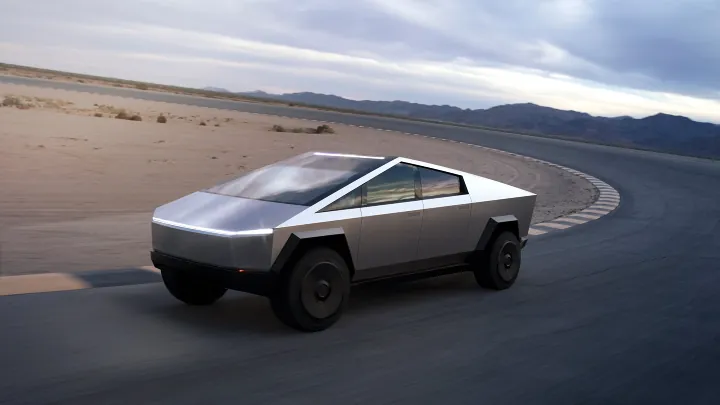
A colleague forwarded a story to me about the ignominious sales performance of the Tesla Cybertruck. As you may recall—or probably don’t recall since there are so many claims and promises that go unfulfilled he makes that they become a blur—Elon Musk had said the company would be selling 250,000 Cybertrucks per year by 2025.
As in last year.
It is reported that in the two years the truck has been available there has been a total of about 59,000 sold, or about 24 percent of the 250,000 that were to be sold in a single year.
Seems odd that the very smart man who runs Tesla can be off by such a wide margin and yet there is not even a blip in the valuation of the company.
Can you imagine if your local weather forecaster said there would be two inches of snow on the way and was off by six inches? If that mis-forecasting happened a regular number of times, odds are that weather person would be doing something else for a living that had nothing to do with meteorological predictions.
One of the things that is often heard when a vehicle is said to be a flop is that it is the current version of the Edsel. Which in some cases—like this one—is not fair to the Edsel. In the three years it was in production there were about 116,000 sold. Better per annum than the Cybertruck.
While that Edsel number is certainly not great, there are other vehicles that were launched with great fanfare and the fanfare was the only thing great about the vehicle.
Remember when the Fiat 500 came back to the American market? It was going to become as popular as pizza. Dealers had to establish special “Fiat Studios” to sell the diminutive car which is, admittedly, cute. Its second year on the US market it hit its sales peak: 43,772. And it went down every year since. In 2024 the electric variant was launched, and there’s been about 5,200 sold since. So from 2011 to 2025 there were about 202,000 sold in the US, or an average of about 14,428 per year. That would be some 43,285 during three years, so the Edsel was well in advance of that.
But this is not to damn the Cybertruck, the Edsel or the Fiat 500.
The Cybertruck was launched with a geometric design that some were aghast at but some claimed to love. Apparently the first group was significantly larger than the second group, which goes to the point that the F-150 Lightning outsold the Cybertruck in the US 2025 and Ford has pulled that truck from production. But the Cybertruck design execution was a stretch, so credit for that.
The Edsel, for the ignominy that history has heaped on it, had an array of advanced tech on it, ranging from a pushbutton transmission with the buttons on the center of the steering wheel hub—and the steering wheel had a “safe” deep-dish design, part of the “Lifeguard” safety package offered for the Edsel. The dashboard had an aircraft-inspired design. The Edsel had its period’s forward-thinking things that are today gushed about by writers describing the latest EV.
And the Fiat 500 was a stalwart attempt to bring molto stile to the streets of America in a car that people could actually afford. Otherwise the only place they would see an Italian car was while watching reruns of Magnum, PI.
But all three of them have something else in common besides comparatively low sales: all of them were predicted to be much bigger than they ever became (or are likely to).
Edsel wasn’t a mere model. It was Edsel Division, a fourth brand joining Ford, Lincoln and Mercury.
The Fiat Division in the US was essentially predicated on the 500. For two years dealers had the hatchback, a convertible variant and a high-performance variant of the 500. In mid-2013 the 500L was added, which was probably best known for having been produced in a plant where the Yugo had been manufactured (to be fair, Fiat invested a lot of money to update the facility, but still. . .). Also in 2013 was the first 500e (electric). 2015 brought the 500X crossover, and 2016 the Fiat 124 Spider.
The 500L and the 124 made it until model year 2020. The 500X was done after model year 2023. Which brought things back to the 500.
The 500 didn’t become as immensely popular as Sergio Marchionne claimed it would. (Seems like he wasn’t right about everything.)
And as for the Cybertruck, it was to be a disruptor to the full-size pickup truck segment that Ford, Chevy and Ram have been so dominant in.
They are still undisrupted.
Some people ask the question “Where’s my flying car?”
I would like to ask the question “Where’s the mass customization?”
Several years back there was a movement toward making products—from Levi’s to Panasonic bicycles—that were specifically tailored for individuals. Yes, these were products that were more expensive than those bought from stock, but these prices weren’t artisanal—which is where the “mass” came into play.
The point is, manufacturing technology developments—such as having one’s lower half scanned and that information being used to drive fabric cutting machines or using lasers to specifically trim bike tubes to the right length—were going to make it possible for individuals to affordably get something suited to them.
And while 3D printing was still a nascent tech back then, it is now full blown.
But what do we have?
Either it is a bit of plastic trim that you can get for a car with your name on it or something that is printed for a Cadillac Celestiq, a vehicle that goes well north of $400,000.
Customized, but not mass.
There is something positive to be said for Edsels, Cybertrucks and Fiat 500s: these are vehicles that are pretty much outliers to the standard offerings.
But a problem is that the manufacturers didn’t want them to be considered that way. They assumed they’d be taken up by everyone and because they aren’t (or weren’t), these vehicles are considered underwhelming at best, or failures at most. Which they aren’t—were it not for the high bar set for all of them.
People want things fast and they want them cheap.
But I believe they are willing to pay for special.
The company that figures out how to use advanced manufacturing technology to pull this off in an effective and affordable way is going to be successful. Perhaps not successful in the context of 250,000 per year, but successful enough to make money in a market where people are paying a lot to get exactly what the guy down the street has.
The choice between “the same” and “special” isn’t hard to make but it seems as though for the most part there has been a default to the former when we really would like the latter.
Long-time automotive journalist Gary Vasilash is co-host of “Autoline After Hours” and is a North American Car, Truck & Utility of the Year juror. He is also a contributor to Wards Auto and a juror for its 10 Best Interiors UX and 10 Best Engines & Propulsion Systems awards. He has written for a number of outlets, ranging from Composites Technology to Car and Driver.
The TTAC Creators Series tells stories and amplifies creators from all corners of the car world, including culture, dealerships, collections, modified builds and more.
Check out Gary’s Substack here. Republished with permission.
[Image: Tesla]
Become a TTAC insider. Get the latest news, features, TTAC takes, and everything else that gets to the truth about cars first by subscribing to our newsletter.
